All-on-4 Dental Implants: How the Treatment Works and What to Realistically Expect
All-on-4 implants can replace a full arch of teeth on four implants. This guide covers the procedure, candidacy, recovery, risks, and what to ask before committ
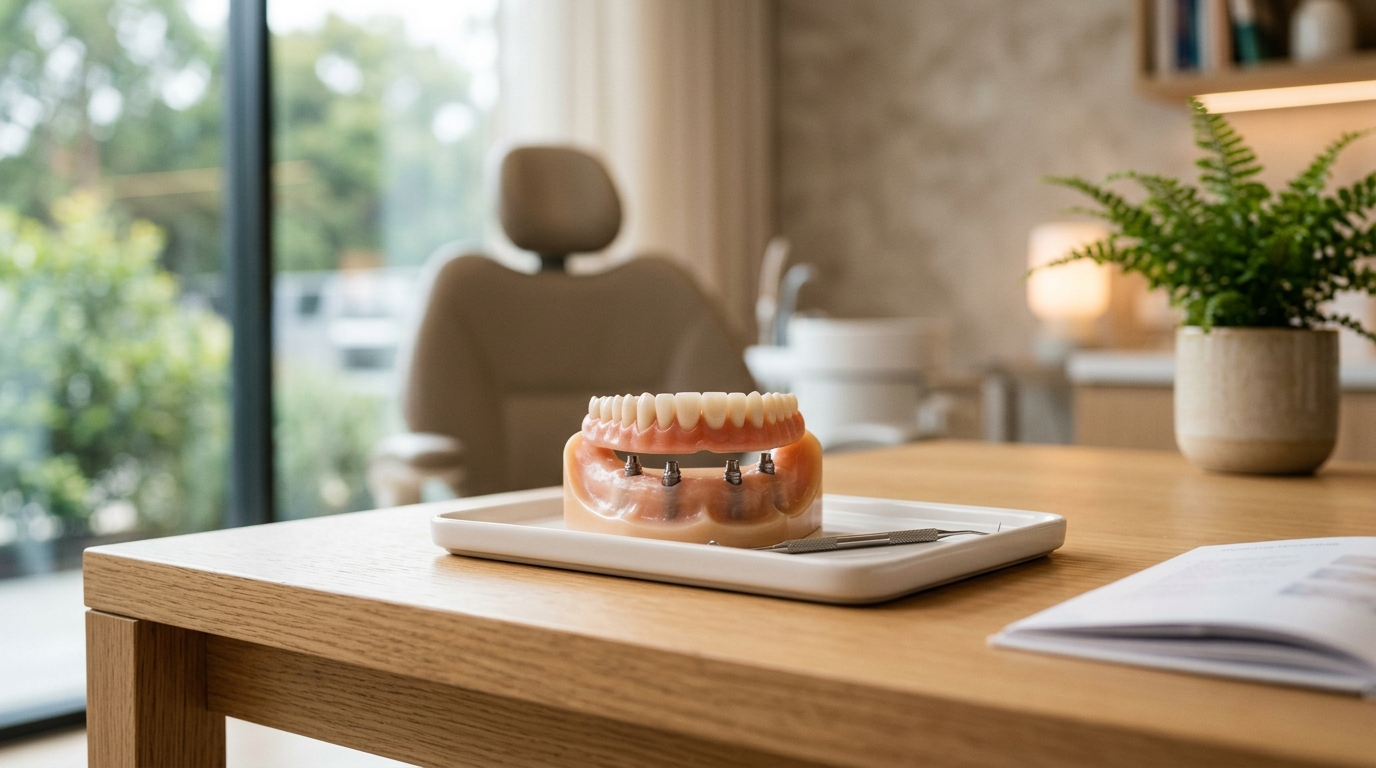
All-on-4 is a surgical approach that replaces an entire upper or lower arch of teeth using four strategically placed dental implants. It is not a cosmetic shortcut. It is a full reconstruction of the jaw's function and appearance, carried out under surgical conditions, and it requires careful evaluation before anyone should consider it.
The concept was developed to make full-arch rehabilitation possible for patients who have experienced significant tooth loss and, in many cases, some degree of bone loss — situations where placing an individual implant beneath every missing tooth would be difficult or impossible without extensive bone grafting first. Whether All-on-4 is appropriate for a specific individual is assessed clinically, not assumed from symptoms alone.
What the procedure actually involves
Four implants are placed into the jaw: two positioned vertically toward the front and two angled at roughly 30 to 45 degrees toward the back. The angled posterior implants allow them to engage a greater volume of available bone without reaching into areas where bone has been lost. A full-arch prosthesis — a bridge carrying typically ten to twelve teeth — is then fixed to those four anchor points.
In most cases, any remaining teeth in the treated arch are extracted during the same surgical appointment, and a temporary prosthesis is attached on the same day. This is where the colloquial description 'teeth in a day' comes from. That temporary bridge allows the patient to leave with functioning teeth while the implants undergo osseointegration — the process by which the titanium implant fuses with the surrounding bone. This takes several months. The permanent prosthesis is typically fitted once osseointegration is confirmed, usually three to six months after surgery, depending on individual healing.
Who is typically considered a candidate
All-on-4 is evaluated for patients who have lost most or all of their teeth in one or both arches, or whose remaining teeth are too compromised to restore predictably. It is also considered for people who currently wear a full removable denture but find it functionally inadequate.
Adequate bone volume — particularly in the anterior jaw — is a prerequisite, since the angled posterior implants are designed partly to work around posterior bone deficiency. A three-dimensional scan (typically a CBCT scan) is used at assessment to evaluate bone density and volume, nerve positions, and sinus anatomy. This imaging is not optional; it is how a surgeon determines whether the anatomy actually supports this approach.
Patients with uncontrolled diabetes, active gum disease, or who smoke heavily carry higher surgical risk and lower implant success rates. These are not automatic disqualifiers, but they are factors a clinician will discuss in detail. Heavy bruxism — persistent teeth grinding — places atypical load on implant-supported prostheses and is relevant to the planning process.
Who is not suitable, and why that matters
All-on-4 is not appropriate for patients with severe bone loss in the anterior jaw, where even the angled approach cannot achieve adequate primary stability. In those cases, bone augmentation procedures may be discussed as a preparatory step before any implant placement. Some patients turn out to be better served by an implant-supported overdenture — a removable prosthesis retained by implants — rather than a fixed bridge.
Patients who are not medically stable, or who are taking medications that significantly affect bone metabolism (certain bisphosphonates, for example), require specialist assessment before implant surgery of any kind. This assessment should happen before any commitment to a treatment plan.
The recovery period: what is realistic
Surgical swelling and tenderness are expected for the first week, and most patients take prescribed pain relief for several days. Diet is restricted to soft foods for several weeks after surgery — the immediate temporary prosthesis is functional but is not designed to withstand normal biting forces while the bone is integrating.
The period between implant placement and fitting the final prosthesis typically spans three to six months, though this varies by patient. Follow-up appointments during this interval are used to monitor healing. If healing progresses as expected, impressions or digital scans are taken for the permanent bridge, which is then fabricated in a dental laboratory.
Once the permanent prosthesis is fitted, ongoing maintenance includes regular professional hygiene appointments, careful daily cleaning around and beneath the bridge, and periodic clinical checks of the implants and prosthesis integrity. An implant-supported prosthesis can develop mechanical issues over years of use — loose components, chipping of the prosthetic teeth, or, more seriously, peri-implantitis (infection around the implant) — and these require professional attention when they occur.
Genuine risks and trade-offs to weigh
Implant failure — where the implant does not integrate or later loses integration — is a recognised complication. It occurs in a minority of cases but is more common where systemic factors such as smoking or poorly controlled blood sugar are present. When one implant in an All-on-4 construction fails, the implications are significant because the entire arch prosthesis depends on all four supports.
Nerve proximity in the posterior lower jaw is a surgical consideration. The inferior alveolar nerve runs through the mandible, and the angled implants are planned specifically to avoid it. Temporary altered sensation in the lower lip or chin can occur; persistent nerve involvement is an uncommon but recognised risk.
The prosthesis itself is not indestructible. Acrylic prostheses in particular are prone to fracture under heavy load. Zirconia prostheses are harder-wearing but more expensive and heavier. The material choice, and its long-term implications, should be discussed at the treatment planning stage.
Cleaning beneath a fixed arch bridge requires specific tools — interdental brushes, water flossers — and consistent technique. Patients who are not prepared to maintain this hygiene routine long-term are at greater risk of peri-implantitis, which can threaten the implants themselves.
Questions worth asking before committing
- What does my CBCT scan show about bone volume, and does it support All-on-4 without grafting?
- What prosthesis material is being proposed — acrylic, hybrid, or zirconia — and what are the practical differences for my situation?
- How many implants will actually be placed? Some plans use five or six rather than four, depending on anatomy.
- What is the contingency if one implant does not integrate successfully?
- Who fabricates the prosthesis, and where? Laboratory quality affects the final result.
- What does the follow-up protocol look like, including after I return home if treatment is abroad?
- What ongoing maintenance is expected, and what are the signs of a problem I should act on promptly?
All-on-4 treatment and medical travel to Turkey
All-on-4 treatment is commonly performed in Istanbul and Antalya, both of which have established dental facilities that routinely treat international patients for implant-based work. A typical stay for the surgical phase — covering the consultation with imaging, any necessary extractions, implant placement, and fitting of the temporary prosthesis — generally spans five to seven days. The final prosthesis fitting, which occurs after the osseointegration period, may require a separate return visit of two to three days, or in some cases can be coordinated with a clinic that communicates with a local dentist in the patient's home country. International patients travelling for this type of treatment commonly have accommodation and airport transfers arranged as part of the overall care coordination. Those considering this route can review dental treatment packages to understand how the logistics of multi-stage treatment are typically structured.
Before making any decision
All-on-4 is a significant surgical and financial commitment with a multi-month treatment timeline. The decision should follow a full clinical assessment with imaging, a candid discussion of risks relative to individual health factors, and clarity about who is responsible for follow-up care once any initial treatment phase is complete. A second opinion from an independent clinician — particularly regarding whether All-on-4 is the most appropriate approach compared with alternatives — is a reasonable step before proceeding.