Comprehensive Blood Tests Abroad: What the Panels Include, Who Should Consider Them, and How to Use the Results
Considering comprehensive blood testing abroad? This guide covers what panels involve, who they suit, realistic limitations, and what to ask before committing.
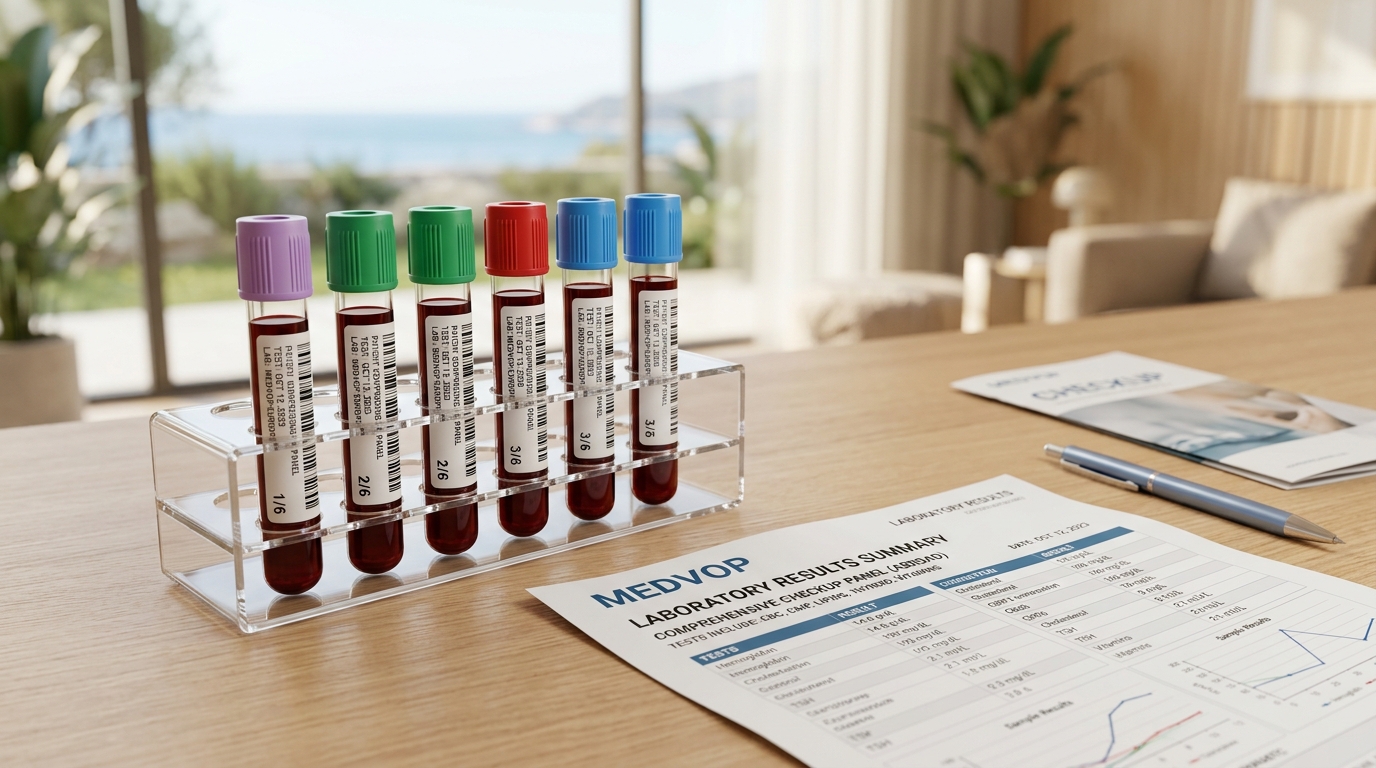
Many adults in the UK and Ireland reach a point where they want a clearer picture of their health than a standard GP appointment provides. NHS waiting times for non-urgent blood panels can run to weeks, and the panels offered are often restricted to what is clinically indicated at that moment. Travelling abroad specifically for a structured, broad-spectrum blood test programme is now a practical option that a growing number of people are choosing — not because something is wrong, but because they want to know.
This article explains what comprehensive blood testing actually involves, which panels are commonly included, who is and is not well served by this kind of screening, what the genuine limitations are, and what a person should clarify before committing to a programme.
What a comprehensive blood test programme typically includes
The phrase 'comprehensive blood tests' is not a single standardised panel — it is a shorthand for a collection of tests grouped into a screening programme. The exact composition varies between providers, but most structured programmes cover the following categories.
- Full blood count (FBC): measures red cells, white cells and platelets, and can flag anaemia, infection, clotting abnormalities and certain haematological conditions.
- Metabolic panel: covers kidney function markers (creatinine, urea, eGFR), liver enzymes (ALT, AST, GGT, ALP), electrolytes and blood glucose.
- Lipid profile: total cholesterol, LDL cholesterol, HDL cholesterol and triglycerides, used to assess cardiovascular risk.
- Thyroid function: TSH and, if indicated, free T3 and free T4, which assess how well the thyroid gland is regulating metabolism.
- Inflammatory markers: C-reactive protein (CRP) and erythrocyte sedimentation rate (ESR), which indicate whether systemic inflammation is present.
- Diabetes markers: fasting glucose and HbA1c, the latter reflecting average blood sugar over the preceding two to three months.
- Nutritional markers: vitamin D (25-OH), vitamin B12, folate, ferritin and iron studies are commonly included in broader panels.
- Hormonal assessment: depending on the programme and patient age, panels may include testosterone, oestradiol, DHEA-S, cortisol or thyroid antibodies.
- Cancer marker panels: PSA for men, CA-125 for women, and sometimes CEA or CA 19-9 — though these require careful interpretation (see the limitations section below).
Some programmes also include a urine analysis, which provides additional information on kidney function, glucose spillage and early signs of urinary tract pathology. The scope of the programme is usually agreed during an initial consultation or intake process; it is not one-size-fits-all.
How the testing process works in practice
Blood is drawn after a fasting period, typically eight to twelve hours, so morning appointments are standard. A single venepuncture is usually sufficient regardless of how many panels are included, because the drawn volume is divided between different sample tubes. The patient spends very little time in the clinic at this stage — often no more than thirty to sixty minutes.
Processing times vary by panel. Routine biochemistry and haematology results are typically available within a few hours to one working day. Hormonal assays and some specialised markers may take longer, particularly if samples need to be sent to a reference laboratory. A well-structured programme returns a full set of results with a clinician's written interpretation before the patient departs, or delivers them digitally within a defined window.
Results review is part of the process, not an optional add-on. A physician or clinical biochemist explains which values fall outside reference ranges, what the deviation means in context, and whether follow-up testing or a specialist referral is warranted. This interpretation session is where the programme delivers most of its value — raw numbers without context are of limited use to most patients.
Who is well suited to this type of screening
Comprehensive blood testing tends to be most useful for adults who are broadly healthy but have not had a structured review of their baseline markers, adults with a family history of cardiovascular disease, type 2 diabetes or certain cancers, people experiencing non-specific symptoms — persistent fatigue, weight changes, mood disturbance — that have not yet been investigated, and those at career or life stages where having clear baseline data makes practical sense.
It is less suited to people who are acutely unwell, who are already under active investigation by a specialist, or who have a known diagnosis that requires a different management pathway. In those situations, the right setting is the existing clinical team, not a travel-based screening programme.
Age is a relevant factor in which panels are included. Hormonal panels and prostate or gynaecological markers become more relevant from the mid-thirties onwards; the appropriate composition of a programme for a 32-year-old differs from one designed for a 55-year-old. This is typically assessed at the intake stage.
The genuine limitations and trade-offs
Blood tests detect what is circulating in the bloodstream at one point in time. They do not directly assess organ structure, tissue changes, or conditions that do not produce measurable serum markers at their early stages. A comprehensive blood panel can reassure — or prompt useful further investigation — but it is not a guarantee that nothing is wrong, and a normal set of results is not a certificate of health.
Cancer markers warrant particular attention. Serum markers such as PSA, CA-125 and CEA are screening aids with known limitations: they can be elevated in benign conditions (PSA rises with prostate inflammation and age, for example) and can be within normal range in the presence of early malignancy. A positive marker finding requires follow-up imaging and specialist assessment — it is not a diagnosis. Conversely, a normal marker does not rule out disease. Patients considering programmes that include cancer markers should understand this before they request them.
Reference ranges are population-based and may differ slightly between laboratories and between countries. A result that falls marginally outside the reported range is not automatically clinically significant; equally, a result within range may still represent a change from a patient's own baseline. Longitudinal tracking — repeat testing over time — is generally more informative than a single measurement, which is why some programmes build in a follow-up panel six to twelve months later.
Finally, the results need to reach the patient's GP or primary care provider at home. A screening programme that generates findings without facilitating that handover is incomplete. Asking how results are formatted and shared with a home clinician is one of the more practical questions a patient can ask in advance.
How comprehensive blood testing fits within a broader check-up programme
Blood tests are one component of a full health assessment. Many patients who travel for this purpose combine blood testing with other investigations — resting ECG, body composition analysis, abdominal ultrasound, spirometry or a physician-led consultation — as part of a structured health screening day. The advantage of combining investigations in a single visit is that the interpreting physician can look across multiple data sources at once, which improves the quality of the overall assessment.
For those considering a structured assessment, executive check-up packages typically bundle blood panels with additional investigations and physician review into a single-day or multi-day programme, which can be a practical way to cover a broad range of baseline markers in one visit.
Questions worth asking before committing to a programme
- Which specific tests are included in the panel, and which are excluded? Ask for the full list rather than a category summary.
- Is there an initial consultation where the panel composition is adjusted to your age, sex, family history and current concerns?
- What laboratory accreditation does the facility hold, and are the reference ranges validated for European populations?
- How quickly are results available, and in what format — printed report, digital portal, or both?
- Is a results interpretation session with a physician included, and for how long?
- If a result is outside the reference range, what is the protocol — is there an on-site specialist, or does follow-up rely on the patient's home GP?
- How are results shared with your GP or existing specialist at home — and in what format are they provided?
- What happens if a result requires urgent clinical action during your stay?
Travelling to Turkey for blood testing and health screening
Comprehensive blood testing and broader health screening programmes are commonly performed in Istanbul and Antalya, which have established hospital and private clinic infrastructure accustomed to receiving international patients. Istanbul in particular has a concentration of multi-specialty private hospitals that conduct health screening as a dedicated service line, with on-site laboratories capable of processing a wide range of panels.
A programme combining blood tests, physician consultation and any additional investigations can typically be completed within a single day, though patients who include imaging studies or wish to have a follow-up interpretation session often plan a stay of two to three days. This allows time for all results to be processed and reviewed without the patient being in transit before the consultation takes place.
International patients typically travel in as private individuals — the logistical footprint is small compared with surgical procedures. Accommodation and airport transfers are commonly arranged for patients attending health screening programmes in both cities, either directly through the facilitating organisation or through standard hotel and transfer services. No extended recovery period is required; most patients fly home the same day they receive their results, or the following morning.
Making use of the results when you return home
The value of a blood panel depends heavily on what happens after it. Bringing a full printed or digital report to a follow-up appointment with a GP allows the results to be integrated into an existing clinical picture. If the programme has identified a value that warrants further investigation — an elevated liver enzyme, a borderline HbA1c, a low vitamin D — the GP can arrange appropriate follow-up within the NHS or through a private specialist, whichever is more practical.
Keeping a copy of the results also establishes a personal baseline. Blood markers that appear normal at 45 may read differently at 50 if a patient's own trajectory is tracked over time. A single set of results is a starting point, not a complete picture.